Social Media Put Simply

I recently came across this photograph that basically put social media in simple terms.  As everyone should know, social media is a way for you to connect to people online.  So, I wanted to share my thoughts about some of the social media sites I use everyday and how they help me.

Facebook

I use Facebook to interact with my friends about my personal life.  I like to see what my friends are doing in their lives as well, it keeps me up to date especially if I don’t see people on a regular basis.  Facebook also allows me to promote interests of mine such as these blog posts I write.  I am able to share my writing with friends and they support me by reading what I have written.  I have also started using Facebook for business purposes.  I manage pages for organizations and businesses which helps me perfect my social media marketing skills, which can be put on my resume and LinkedIn profile.

Twitter

Twitter is a place for me to see what people are doing in the field I am interested in.  On twitter, I can follow Richard Branson and see what updates he has about business.  I essentially use twitter for educational and business purposes.  I like to follow people who are influential in business and can offer valuable advice to young business people like myself.  I can connect with people that I would have otherwise not been able to connect with by other means.

LinkedIn

This is my online resume.  I update my profile constantly on LinkedIn.  It is used to show people the type of experience I have and what activities I have been involved in.  I am able to showcase my articles on LinkedIn in the profile updates, look for jobs, network, and maybe even offer jobs to people I know (in the future of course).

Foursquare

Foursquare is something I recently got into and it’s actually pretty interesting.  I can link it to my Facebook and Twitter accounts when I check-in somewhere.  Personally, I want to see what my friends are recommending because I like to go to new places and experience new things.  If my friends say they like it, then I might like it.  As for business, I want to check to see how my clients are doing in terms of customers checking-in and what they are saying about the business.  This helps us get a sense of what is most popular in the store and what we should focus on when it comes to discounts.

Instagram

I am also new to Instagram and it is actually really fun.  I like to use my creative side when taking pictures and manipulating them into some artsy way.  I like to see what my friends are up to and I am excited to learn more about this outlet of social media.

All outlets of social media are connected.  You can post something on Instagram that you can link to Facebook and Twitter as well.  When you post to Twitter you can link to Facebook or LinkedIn.  There is just so much you can do with social media and it’s fun to interact with a variety of people whether it be school friends, family, professors, co-workers, or even someone who wrote a best selling book.  I am not saying everyone has to use every single type of social media tool, but it’s good to think of them as a way to enhance your personal and professional life.

Entrepreneur Interview- Timothy Gaspar

There are so many entrepreneurs in the world and a handful of them started their businesses when they were attending college or high school.  While some become a big time success such as Facebook creator Mark Zuckerburg there are those small businesses that make a difference in their own communities.  The question is how did they do it?  How were they able to open up and sustain a business while attending school?

To answer these questions, I set out to talk to those entrepreneurs that were able to make their dream of owning a business a reality while pursuing an education.  My first interview is with Timothy Gaspar of Gaspar Insurance Services, Inc., in Woodland Hills.

Q: Tell me a bit about yourself.

A: I live in Woodland Hills, am married and I have a 1 year old son. I’m 30, went to El Camino for High School and CSUN for College, I graduated with a degree in Finance. I owned a small business when I graduated high school so I didn’t originally to go College, but when I met my wife when I was 21 she made me go or she said she wouldn’t marry me. Plus, by that point I had a few good “lumps” from business so I knew I better have a solid foundation.

Q: Tell me about your business.

A: I own an insurance agency. We provide personal insurance policies to individuals and families including earthquake, homeowners, auto, umbrella etc. We also provide insurance for businesses including general liability, workers compensation, professional liability, etc. I currently have 20 people and 2 offices.

Q: Why did you decide to open up your business?

A: I love running a business, it’s my passion. Some part of me enjoys the fact that it’s incredibly challenging every single day (including weekends).

Q: How did you balance your education and your business ventures?

A: I went to school at night via the PACE program. I like being busy, it motivates me. When I’m not busy I noticed I get incredibly lazy. You just find ways to get everything done

Q: What steps did you need to take to open up you business?

A: I did as much planning and work as I could before I left my old firm. I didn’t pull the trigger on stepping out on my own until all my ducks were in a row. Once you take that leap there is no going back so you don’t want to find out you forgot to submit some form to the state that is going to delay you another week.

Q: How did you get your business funded?

A: A big fat loan to start because I had to buy my book of clients from my old agency. But generally I’m not a fan of using debt to expand, I think it usually leads to trouble. I think when expanding your business you should rely on current cash flow, as old school as that seems.

Q: Was your family supportive of your decision to open up your business right out of high school?

A: Not really, but that’s only because they worried. They would have preferred I went directly into college full-time, that just wasn’t me at the time. My spouse however was very supportive when I left my old insurance firm 5 years ago.

Q: What is the biggest obstacle you faced being a student and a business owner?

A: Just managing time. You just take it day by day, you string enough days together you a get a week, then a month, then you’re out of school.

Q: What are the biggest lessons you learned being a student and an entrepreneur?

A: Don’t borrow money if it’s not absolutely necessary. Treat your people exceedingly well, better than the next guy (that includes paying more).

Q: How is your business doing since graduating from college?

A: We have worked really really hard to keep expanding and thankfully we are doing that.

Q: Did you have an mentors to help you start your business? If so, did he/she offer valuable advice?

A: Yes. My Stepdad taught me the value of emotional intelligence in how you treat people, my Dad is just a hustler, pure and simple. I just wanted to work as hard as he did.

Q: Did your education make it easier for you to start your business?

A: Yes, indirectly. Some of my clients and current relationships are people I met in school.

Q: What is one piece of advice you would give to a college student who wants to open their own business?

A: Start small but dream big.

A special thanks to Timothy Gaspar for allowing me to interview him.  🙂

Are you an entrepreneur who started your own business in school? Let me know. I would love to write about your success story.

What Can You Learn From Shield’s Date Garden?

Recently, I took my first trip to Palm Springs.  The hotel was amazing, the food was amazing, and it was nice and hot!  Before we left the area, my boyfriend wanted to stop at a Date Garden.  I have never been to a date garden and only recently started actually eating them.

So, we stopped at the famous Shield’s Date Garden in Indio, CA.  From the outside it does not look like much, but once you walk inside it’s a completely different experience.  There is so much to look at, free samples, a cafe, and their famous date shake.  We walked around looking at all the nik-naks and sat down to grab a bite at the cafe.  I ordered the stuffed dates wrapped in bacon. YUM!

This small business is able to stand out among the rest and has become a place of tourism.  Shield’s Date Farm was founded by Floyd and Bess Shields who brought their love for dates to California in 1924.

Floyd was a pioneer in the date business, breeding his own varieties of dates, such as our famous “Blonde” and “Brunette” dates, that are exclusive to Shields Date Garden and grown nowhere else in the entire world. He also invented the Date Crystal®, a blend of dates turned into a dry product that can be used in cooking, on cold cereals and in everyone’s favorite: date shakes. Date Crystals® do not need refrigeration and when kept in a moisture-proof container will last for many years— without preservatives.

People stop at this place for the dates!  This is truly a niche business and they have successfully taken advantage of it.

I believe there are valuable life lessons to be learned from small businesses such as Shields Date Garden.

1. Differentiate Yourself: If you want people to notice you, you want to be different from everyone else.  You should make a lasting impression on people.  Floyd’s business was able to differentiate themselves because there was no shop like it even close to the area.  Today, their products are still what differentiate them from others.  The key is to make yourself STAND OUT!  On your resume you can make yourself stand out by your volunteer activities.  In the classroom you can make yourself stand out by participating in all the discussions.  You can make yourself stand out at your job by doing more than what is expected of you.

2. Be Passionate About Something: You should strive to do things that you are passionate about.  Whether it is opening up with a business, running a marathon, or writing.  Just do something you enjoy and decide if it is something to pursue as a career or to keep as a hobby.  Floyd was passionate about dates and decided to open up his own date garden.  He even had a short film made, entitled Romance and Sex Life of the Date which is continuously shown inside the shop.

3. Try New Things: I strongly believe that you should try to experience new things throughout your life.  You can take a class outside of your major, try a new food, take salsa lessons, or travel.  Not matter what, you should always try something new everyday even if it is something small.  Floyd tried new things by putting in a cafe and creating new products that are only manufactured by his company.

Have you ever been do Shield’s Date Garden? Please let me know what you think about it in the comments.

A Day at Dun & Bradstreet Credibility Corp. – Working as a Marketing Intern

Just like so many college graduates, in May of 2011 I found myself looking for a job.  I was literally online searching for jobs every single day for several hours.  At this point, I have lost count of how many I have actually applied for.  For a while, it seemed like there was nothing out there for me and nobody would give me the chance to prove myself!  That was until Dun & Bradstreet Credibility Corp. came along…

I had heard of Dun & Bradstreet Credibility from a friend who was able to obtain a full-time graphic design position.  She was so excited to let me know that her company was hiring interns like crazy and suggested that I should apply.  At the time, I hadn’t thought about applying for an internship because I was looking for that full-time position.

However, I had enrolled in the MBA program at Woodbury University, so my time was still split between work and school.  Then I thought….”Hey, a part-time internship might actually be better for me”.  Considering it’s a paid internship, I would still be making something!  I looked into Dun & Bradstreet Credibility and found that I actually liked the company.  They are in the business of helping small businesses.  As a student who studied entrepreneurship, I felt this was a perfect fit.

After a rough holiday season, (still no job offers, went on countless interviews, and no word from DandB) I was falling into a state of depression.  I couldn’t sleep, I had anxiety from bills piling up, and at times I would sit in my car just to cry.  But then I got a call…..”Hi, is Danielle there?”… “This is Danielle.”…”Hello, this is Catherine from Dun & Bradstreet Credibility Corp.  We would like to bring you in for an interview, if you were still interested.”

Finally!!! I immediately said YES! I scheduled the interview and started preparing. 🙂

The Interview

To prepare for the interview, I printed out several copies of my resume, cover letter, writing samples, and brought  a business plan I had written for a competition.  I was prepared for this interview! I knew the questions I would ask at the end of the interview, knew where I had to drive to, and where to park.  I showed up an hour early and sat in my car going over everything I had printed out about Dun & Bradstreet Credibility.  I made sure I knew enough about their products/services and the company’s history, in order to show my genuine interest in working at the company.

Lets just say, I was extremely nervous (like I am for most interviews).  There is always that voice in the back of my mind saying, “Danielle, don’t mess this up.  You need this.  Stay calm.”  When the time came for me to head into Dun & Bradstreet Credibility, I was greeted with a smile and an excited “Hi!” from Catherine, the Marketing Coordinator.  The atmosphere in the office had a fun vibe to it; walking in for the first time, I literally almost got run over by someone riding a scooter.

Catherine brought me over to one of the conference rooms overlooking the ocean! It’s such an amazing view and it was such a beautiful day!  Once I got settled into the conference room…the interview started.  This interview was very different from all the ones I had been on with other companies.  Each person I met with talked so passionately about Dun & Bradstreet Credibility and I knew that this would be a good place to work (If they offered me the position of course). I left that interview feeling confident in myself and what I could bring to this company.

About a week after my interview I got a call.  I looked at the number and thought to myself, “This is it!”  Sure enough, it was Catherine letting me know they wanted to hire me as a Marketing Intern!

Meeting Jeff Stibel, CEO of Dun & Bradstreet Credibility Corp.

After I was offered the marketing intern position, I was told I had to meet with the CEO of the company.  This was another indication that Dun & Bradstreet Credibility is very different from most companies.  I had never met the CEO of a company I was interviewing with, so I was extremely nervous.  It wasn’t even an interview, but the concept of meeting the CEO made me sweat a bit.  So, I scheduled the meeting and met with Jeff Stibel.  He told me about himself, how he started Dun & Bradstreet Credibility Corp., and asked about me.  I am quite certain that he knew I had this whole blurb about myself memorized word for word.  After that meeting, I was even more excited about my first day as a Marketing Intern!

Working at Dun & Bradstreet Credibility Corp.! 🙂

When I was getting ready for my first day at Dun & Bradstreet Credibility, I told myself that I am going to work extremely hard!  I am going to make myself stand out of all among the rest!  I will make a name for myself here!

I started working on Valentine’s Day! Since my first day, I have learned so much and have been given more responsibilities than I thought I would.  This is in no way a bad thing because the more responsibilities I am given, the more I learn and the more opportunities I have to prove myself.

Not only do I like the work I am given, but I like the company culture.  Dun & Bradstreet Credibility is one of those companies that is not just about the customers, but also about their employees.  From my time spent here, I can tell that Dun & Bradstreet Credibility wants to make sure that their employees are motivated and happy.  This is why people working here are so passionate about their work and making Dun & Bradstreet Credibility a success.

As a group, Dun & Bradstreet Credibility employees are all about working hard and playing hard.   Every month there is at least one party in the break room.  The break room itself is an employee’s dream!  Equipped with a pool table, two televisions, video games, a ping-pong table, an arcade game, an air hockey table, and did I mention the drinks and snacks; this break room makes everyone I know jealous!  While Dun & Bradstreet Credibility employees may take breaks to challenge each other to a game of ping-pong, this company is extremely hard-working!  Dun & Bradstreet Credibility is in it to win it!  That’s how I see it.

Overall, I am extremely grateful to be a part of this amazing company.  I know that I will learn a lot from my days working here and I can’t wait to continue contributing to the success of Dun & Bradstreet Credibility.

As a College Student, What Can You Learn From This?

Before you apply for a job:

  • Make sure your resume is up to date, has no spelling errors, and looks and sounds professional.
  • Create a cover letter stating the reason why you are applying and why you think you are qualified.

When you get the interview:

  • Be sure to research everything about the company (i.e. products/services, history, requirements of the position you are applying for, etc.).
  • Print out several copies of your resume, cover letter, and any other materials you feel is necessary (I would say print out at least 3 copies of each).
  • Be sure to arrive early.  You NEVER want to be late!

When you get the job:

  • Take on as many responsibilities as you can.  This will help you prove yourself in the company.
  • Show that you are interested in the company and get to know your coworkers.
  • Most of all you should be having fun!

Please tell me about your amazing job! 🙂

College Students – What to Do After a Family Member’s Passing

The hardest thing a college student will every go through is the death of a family member, especially immediate family members.  Once you hear the news, you ask yourself what do I do now? Do I drop out of school, take a semester off? Or do I stick it out and hope I pass my classes?  These are not the types of questions you want to think about during a time as difficult as a family member’s passing, but it’s important that you do.

I can tell you from experience that it is possible to get through it and continue with your education.  You shouldn’t give up, but instead use your education as a way to keep your mind off of what’s going on in your life.  When my mother passed during my second year of college, I did consider dropping out, but realized that overall it would be a bad idea.  So, I set out to catch up with my schooling after I had taken three weeks off.  For those college students that don’t know how to continue the semester after a family member has passed, I have included some helpful tips.  Just don’t give up and keep on going!

  1. Talk to the Right College Officials:  The best thing for you to do is talk to a college official that specifically works for the well-being of the students.  When I needed to take three weeks off of school to go through my mother’s belongings, I went to the student development center at Woodbury University.  This staff member helped me out by contacting my professors and gave me the paperwork I needed to fill out.
  2. Fill Out the Necessary Paperwork: If you feel you need to take some time off there is paperwork that you must fill out.  The process is different for every school so be sure to find out what is required from your school.  As for me, I had to make a request for a leave of absence and provide the appropriate paperwork to prove my mother’s passing, which meant I had to bring in my mother’s death certificate.  This may seem wrong, but is quite necessary for both you and the school.  It protects the school and enables them to help you during this difficult period.
  3. Talk to Your Professors: While the staff member you spoke with will contact your professors, you should still take the time to contact them yourself.  Tell them about the circumstances and ask if they can provide you with class materials that will be covered during your time off.  This will show them that you are still thinking about your education, but need some time to deal with family matters.
  4. Get Help: There may come a point when you need to ask for help to catch up with any work you missed.  I decided to use the Academic Peer Mentor program, at Woodbury University, to help me catch up and manage my time after I had returned to school.   Take advantage of programs that your school may offer to help students with their school work.
  5. Talk to Someone: Another thing that my school offered was counseling.  Honestly, I am the type of person that hates taking to people I don’t know about my issues.  But I decided that going to counseling, on campus, might help me cope with the loss of my mother and focus on my school work at the same time.  It actually did help!  I was able to talk to someone who would listen to  me about whatever.  You don’t necessarily have to talk to a counselor, but talking to someone about how your feeling will help the grieving process.

Presentation Techniques

As a college student and entrepreneur, you want to take the necessary steps to improve your presentation techniques.  This will help ensure a better grade in class and/or a potential investment in your business.  Being a college student and aspiring entrepreneur myself, I have learned several techniques that have made my presentations more impactful for the audience.  I have primarily used the guidelines that one of my professors at Woodbury University gave his students, which are as follows:

Structure of your presentation

  1. Start with a hook to get the audience interested.
  2. Introduce yourself, teammate, and topic.
  3. Don’t do a standard “I’m going to talk about Main Point 1, Main Point 2, Main Point 3.” It’s boring. It’s ok to showcase in an interesting way what you’ll be talking about, but it should feel natural.
  4. Have an actual conclusion. Wrap up with a summary statement and give some sort of high-level application/conclusion/broad-impact statement.
  5. Say ‘thank you’ or ask for questions, not ‘well, that’s all I have!’

Voice

  • Don’t end sentences with a question.
  • Be loud enough so that the person in the back of the room can hear you.
  • Don’t use filler words like ‘umn’ — remain silent instead.
  • Breath between each sentence.
  • Use short sentences.
  • Leave a longer pause between main points.

Energy

  • Sound like you’re happy to be presenting.
  • Smile!

Posture

  • Stand with your feet flat on the ground.
  • Don’t shift your weight back & forth.
  • Shoulders back.
  • Hands down at your side when not gesturing.
  • Move between points. Take at least 3 steps.
  • Move around the room. Don’t worry about the camera. Don’t worry about standing in front of the slides.

Engagement with Audience

  • Make 2-3 second eye contact with each member of your audience.
  • Look at them until you feel engaged/connected, and then move on.

Notes

  • Do not read your slides or notes! The best way to do this is to ensure that you can’t read the slides by only putting up critical information/fragments/nouns. Do not put full sentences on your slides.
  • Put big ideas on your notes (if you *must* use them). Don’t put the same thing on your notes as it on the screen.
  • Do *not* write out an entire speech.
  • Be careful about looking at your presentation on the screen. Make sure you’re primarily looking at the audience, and not cycling back & forth.

My advice is that you should practice your presentation several times in front of people you know.  Ask these people to give you constructive feedback to help you make your presentation better.  I have also found that recording myself on a video camera is helpful in order to see exactly what I need to work on.  From watching my presentations first hand, I was able to see that I played with my hair a lot which can be very distracting to the audience; since then I have corrected that.

Gestures

  • Big gestures are calming
  • Little gestures are nervous
  • Don’t do the ‘chipmunk with a nut’ posture of holding your hands in front.

Slides

  • Use as a guideline no more than 6 points on a slide, with at most 6 words per line. E.g., 6×6 Rule.
  • Do not rely on the audience to read your presentation. They should be focusing on you, and not your slides. Slides are a supplemental feature. Visual elements are good *if* they support your point.
  • Don’t rely on videos too much, we’re here to listen to you!
  • Slides should use readable font size and color. Projects usually wash out the colors, so be sure to have high contrast artwork/font.
  • Don’t use the progressive reveal. You almost always end up clicking, clicking, clicking, and then talking. There are occasionally good times to use this feature, but only use it if it’s important that your audience see elements at a specific time.
  • Don’t use animations unless they’re directly related to the point you’re trying to make.
  • Spellcheck!

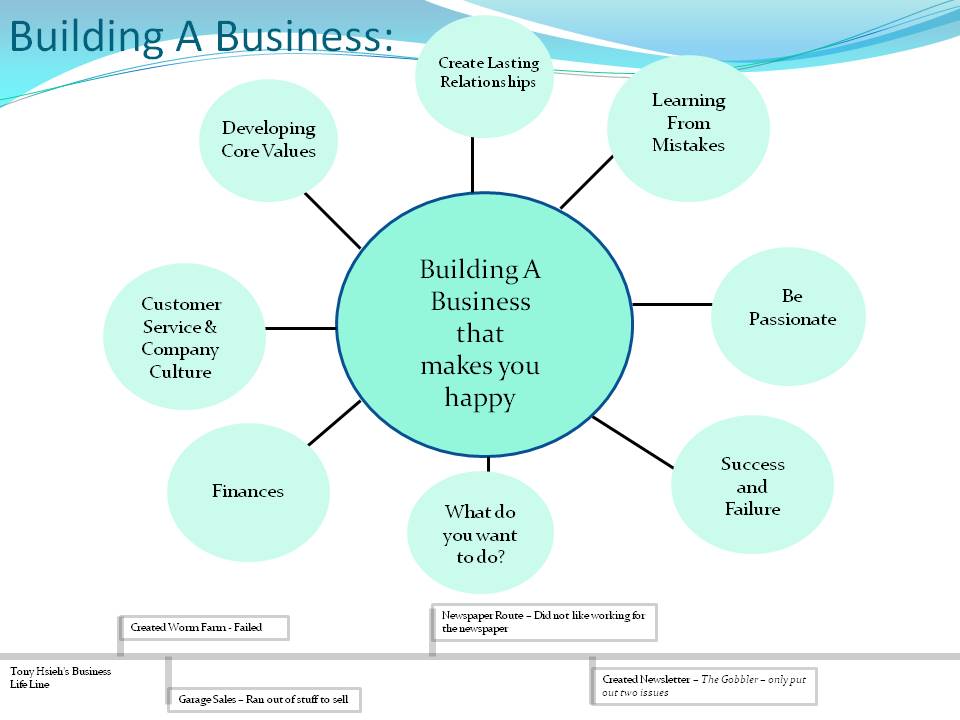
While I was an undergraduate student, I took an Information Technology course and made a presentation on the book Delivering Happiness: A Path to Profits, Passion, and Purpose by Tony Hsieh.  I received a perfect score for my overall PowerPoint style.  I have included some of the slides here for you reference:

As you can see, I did not put long paragraphs in my presentation.  I instead used a lot of graphics and very few words to illustrate a point.  I wanted my audience to be listening to what each point meant as well as make my presentation more eye-catching and interesting.  I also added a timeline of relevant events that happened in the book.  These types of additions can increase the interest your audience has with the content.

Time

  • Take up the available time, but don’t go over. A good rule of thumb is that if you have a 10 minute presentation, you should aim for 9 minutes in practice. You’ll probably talk faster in the actual presentation. You shouldn’t be shorter than 8 minutes.

Plagiarism

I know from experience that this is a lot to think about during a presentation.  Honestly, you will never get it right every time, but practicing always makes perfect.  I have had to work on a lot in my presentations such as my voice which includes my volume, quality, and breathing.  I have also worked on my transitional movements between main points.  Now, if I think back to my presenting techniques during my first year in college to my presenting techniques today, it seems like I am a completely different person. My presentations are more effective now and I am more confident during them.

It is always a good idea to improve your presenting skills.  It helps you get your point across more effectively during class.  If you are pitching a business idea to an investor it will show them that you are well prepared and they will take you more seriously.  These presentation techniques can be used for anything, not just for class or to pitch a business idea; they can be used in any presentation setting.